Problem
Many automated insulin-delivery systems remain hybrid closed-loop systems: people must announce meals and estimate carbohydrates. This project asks how sequential decision-making methods can reduce that manual burden while accounting for delayed dynamics, partial observability, individual variability and safety-critical failure modes.
System
The work is an ecosystem rather than a single model:
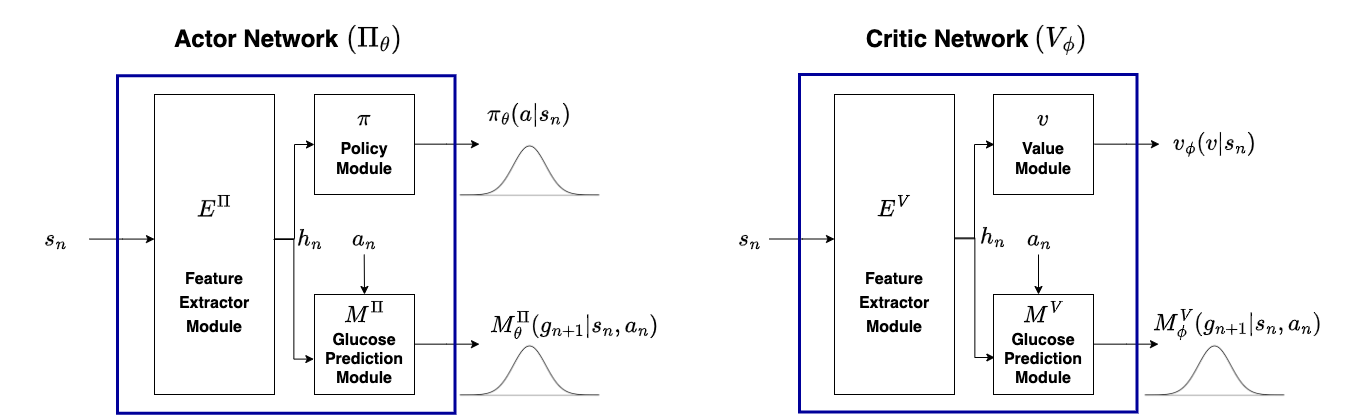
- G2P2C is a reinforcement-learning algorithm built around policy optimization, a learned glucose-dynamics model and a planning phase.
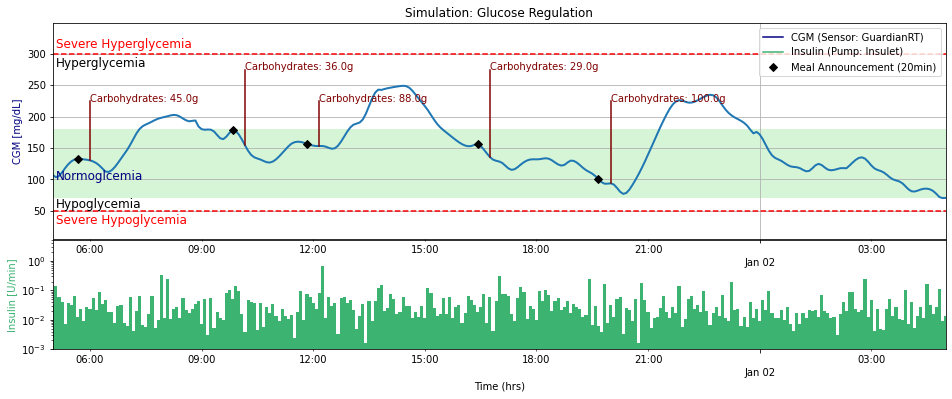
- CAPSML is an interactive research and education interface for running virtual Type 1 Diabetes scenarios and inspecting glucose and insulin trajectories.
- GluCoEnv provides vectorized, PyTorch-based in-silico subjects and benchmark controllers.
- RL4T1D provides a cleaner research codebase for agents, environments, experiments, logging and benchmarking.
Technical contribution
G2P2C augments a learned dosing policy with auxiliary model-learning and planning phases. The model-learning phase estimates short-term glucose dynamics; the planning phase uses that model to refine actions over a short horizon. The wider software stack separates algorithms, virtual subjects, experimental protocols, metrics and visualization so that methods can be compared reproducibly.
Results / demonstration
The published evaluation compares strategies across simulated Type 1 Diabetes cohorts. All reported results are in-silico; they should not be interpreted as clinical validation or autonomous deployment evidence.
Open-source resources
- CAPSML (opens in a new tab) — interactive virtual glucose-control platform.
- G2P2C (opens in a new tab) — original algorithms and experiments.
- GluCoEnv (opens in a new tab) — GPU-oriented physiological simulation environment.
- RL4T1D (opens in a new tab) — modular research infrastructure for online and offline RL.
Paper
“G2P2C — A modular reinforcement learning algorithm for glucose control by glucose prediction and planning in Type 1 Diabetes” (opens in a new tab) was published in Biomedical Signal Processing and Control in 2024.