Machine learning for adaptive biomedical systems.

I build sequential decision-making, generative modelling and simulation methods for complex biological systems—from closed-loop insulin delivery to neuromodulation.

Reinforcement LearningScientific MLDynamical SystemsComputational Neuroscience
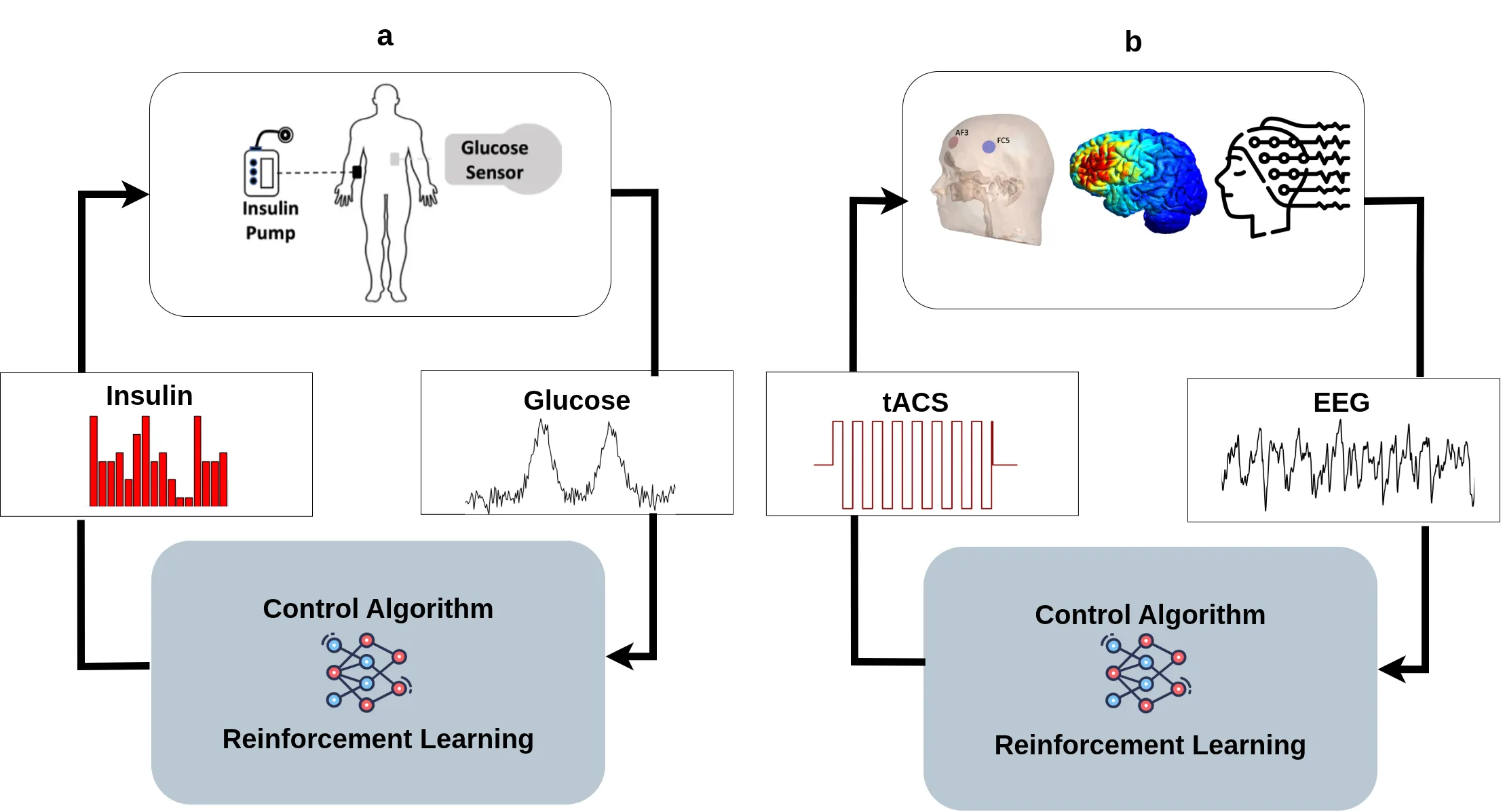
Two closed-loop research systems: glucose measurements guide a reinforcement-learning algorithm that selects insulin doses, while EEG observations guide an algorithm that selects transcranial alternating-current stimulation.
Closed-loop control across (a) insulin delivery and (b) brain stimulation: physiological signals inform a learning algorithm, which selects the next intervention.

Featured work

NeuroStimEnv

Closed-loop brain stimulation as a computational control problem

Full project →

NeuroStimEnv is an open-source simulation framework for combining biophysical neural circuits, simulated EEG, transcranial stimulation and reinforcement learning for treatment discovery.

It integrates NEURON, LFPy and SimNIBS and supports reinforcement-learning formulations in which neural activity provides observations and stimulation parameters define treatment actions.

Technical summary

  • Biophysically detailed depression and healthy cortical microcircuits
  • A 1,000-neuron case study evaluated at 0.025 ms temporal resolution
  • MPI/HPC experiments reported using 624 CPU processes
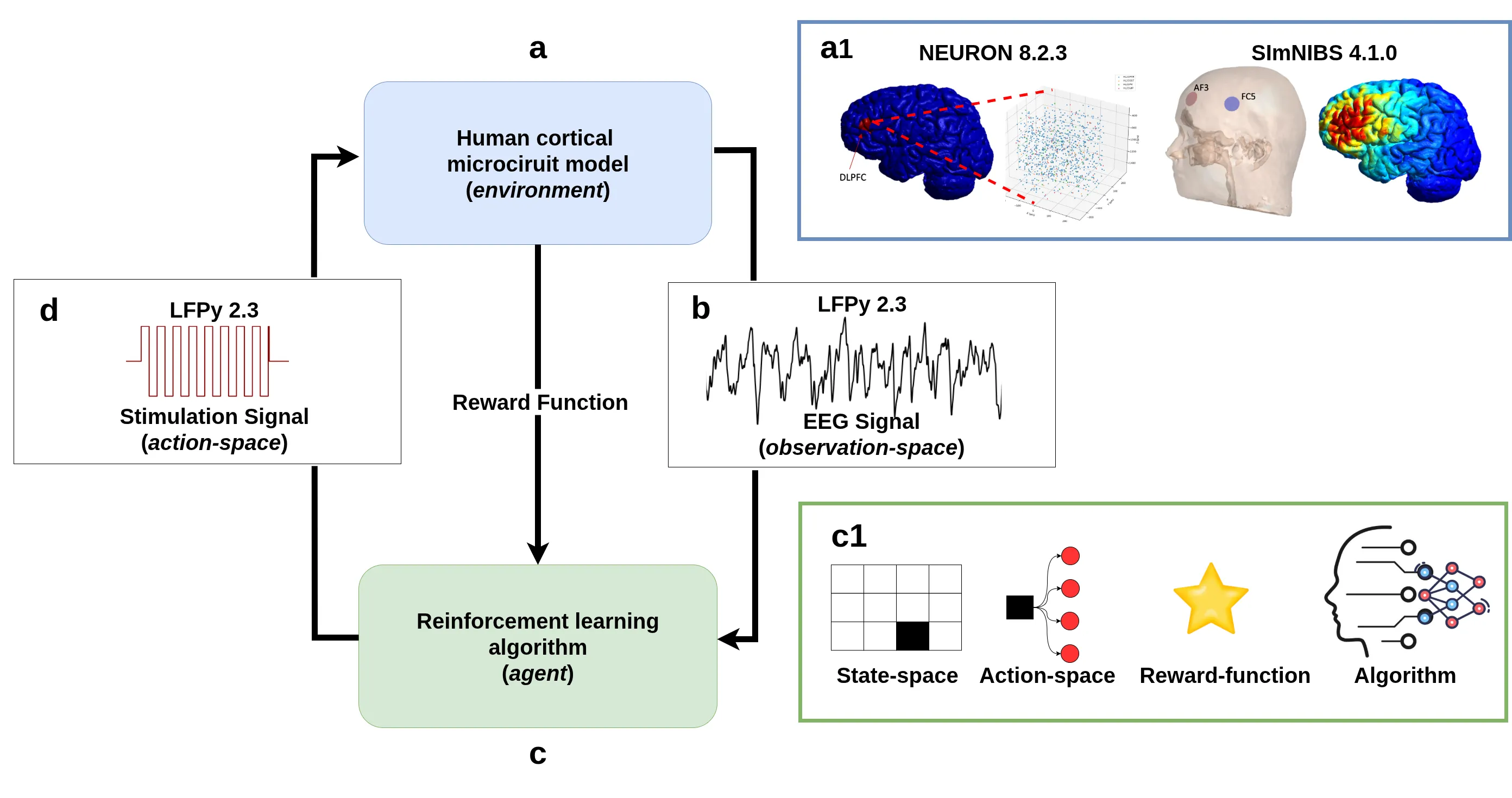
Closed-loop NeuroStimEnv workflow: a human cortical microcircuit produces simulated EEG observations; a reinforcement-learning agent selects stimulation actions that feed back into the circuit. NEURON, LFPy and SimNIBS provide circuit, signal and stimulation modelling.
The simulation loop: neural activity provides observations, a learning agent chooses stimulation parameters, and the circuit responds. This framework supports computational experiments; it is not clinical validation.
Reinforcement LearningComputational NeuroscienceEEGNEURONSimNIBSLFPy

CAPSML / G2P2C

Towards fully closed-loop artificial pancreas systems

Full project →

A research ecosystem for learning adaptive insulin-dosing strategies that reduce dependence on manual meal announcements and carbohydrate estimation.

G2P2C combines reinforcement-learning policy optimization with glucose dynamics modelling and short-horizon planning. CAPSML exposes the research through an interactive simulation platform, while GluCoEnv and RL4T1D provide reusable open-source research infrastructure.

Technical summary

  • A POMDP formulation for insulin dosing without meal announcements
  • Policy optimization augmented with learned glucose dynamics and short-horizon planning
  • Interactive inspection of virtual glucose-control experiments in CAPSML
An illustrative in-silico glucose-control experiment. Blue shows sensed glucose, red marks meals, and green shows insulin delivery. Use the playback controls to pause or replay the animation. These are simulated signals, not patient data.
Reinforcement LearningSequential Decision-MakingControlPOMDPsPyTorchBiomedical AI

Open-source research systems

Reusable infrastructure for simulation and sequential decision-making

Full project →

A set of public research systems for virtual Type 1 Diabetes experiments, reinforcement-learning benchmarks and interactive analysis.

GluCoEnv, RL4T1D and CAPSML make physiological simulation, algorithm comparison and result inspection available beyond a single paper implementation.

Technical summary

  • Vectorized PyTorch environments for virtual Type 1 Diabetes subjects
  • Online and offline RL experiment infrastructure
  • Configurable scenarios, sensors, pumps and benchmark controllers
Open SourcePyTorchSimulationOffline RLBenchmarking

What I build

Methods and systems that connect learning algorithms to scientific models, simulation environments and real experimental constraints.

Sequential decision-making

Reinforcement learning, offline RL, contextual and multi-armed bandits, adaptive control and POMDP formulations.

Scientific machine learning

Generative modelling, flow matching, learned dynamics, surrogate modelling and time-series ML.

Computational modelling

Biophysical neural circuits, physiological simulation, EEG and signal processing, and dynamical systems.

Research engineering

PyTorch, NEURON, LFPy, SimNIBS, MPI/HPC, experiment infrastructure and reproducible open-source research.

Contact

If you would like to discuss research systems, sequential decision-making or machine learning for biomedical science, email is the most direct route.